
Trace Nicholas County Former Owners
The Nicholas County Clerk holds the deeds and the grantor-grantee index. Together they make a chain of former owners possible. Treat each transfer as one row in a working list. Copy the date, the party direction, the deed type, and the book and page reference exactly as recorded. Those small details keep similar names and separate tracts from blending together in your property search.
| Transfer Date | Grantor to Grantee | Deed Type | Book/Page |
|---|---|---|---|
| Newest deed's recording date | Prior owner to present grantee | Copy the instrument label | Copy the current citation |
| Prior acquisition date | Earlier grantor to that prior owner | Copy the instrument label | Follow the prior-recording clause |
| Next matched transfer | Repeat one link farther back | Note estate or court deed | Match the same legal description |
For recent index work, eCCLIX is the online route. When that path ends, shift to deed books or microfilm held by the Kentucky Department for Libraries and Archives. The county's first indexed year online stays behind the account wall. So never treat the archive's span as a measure of online coverage. A nineteenth-century question should start with the archive inventory instead.
The Nicholas eCCLIX login screen is the gateway searchers use for current index work.
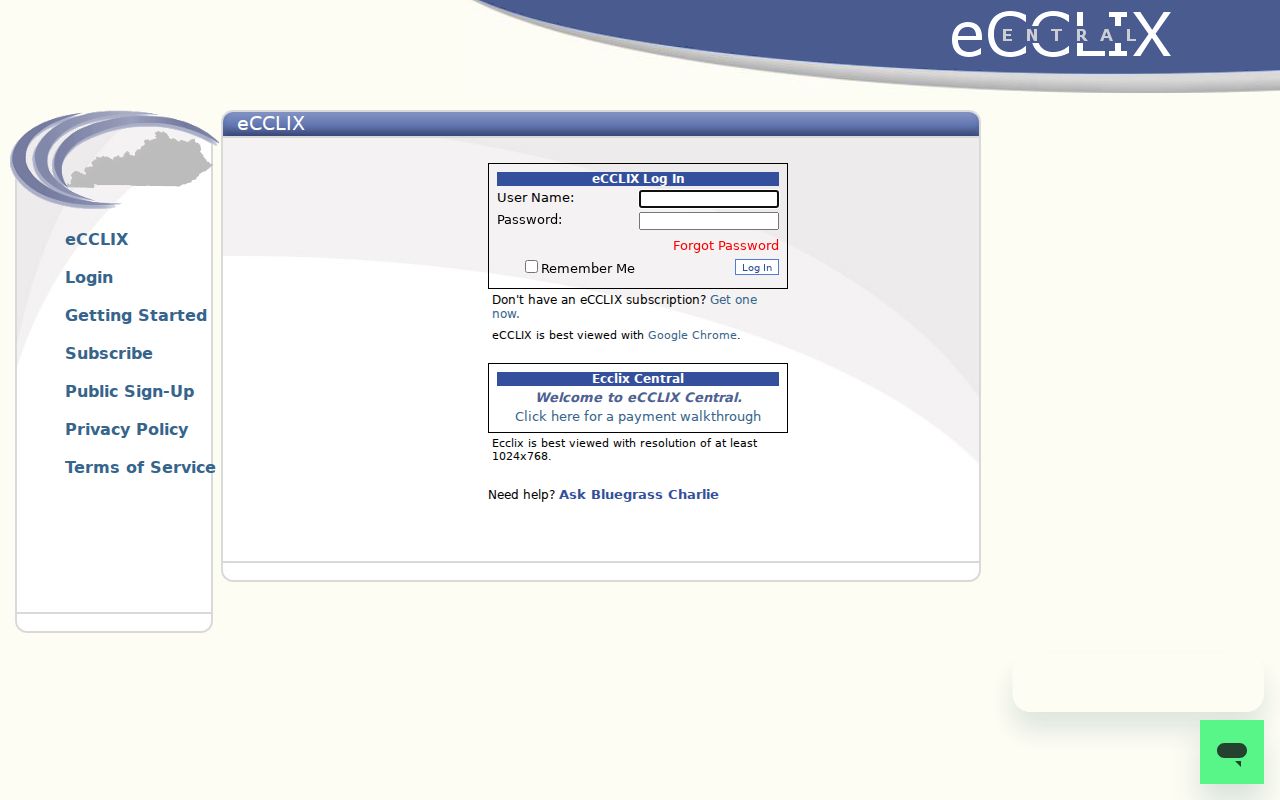
The screen shows the online route exists. It does not reveal the first year indexed, and it displays no Nicholas County deed result on its face.
Nicholas eCCLIX Coverage Gap
The Clerk directs searchers to eCCLIX, which offers login, public-account, and paid-subscription routes. The first Nicholas County index year cannot be confirmed without account access. No live result appears without it either. The public sign-up page has also shown an odd zero-search daily limit. Check current terms with the vendor before leaning on that route for your property search.
Search every former owner as both grantor and grantee. Try initials, spouses, former names, trusts, estates, heirs, and exact entity spellings. The Clerk adds images weekly. A missing scan does not mean the instrument is absent from the deed records.
KDLA Deeds Reach 1800
The KDLA land-record inventory lists Nicholas County deed microfilm covering 1800 through 2013. That run of deed records is the firm time-depth route for previous owners. Those owners predate anything reachable online. It does not promise every year is digitized.
Use the archive's deed guide and microfilm service to pinpoint a roll. Record the volume, page, names, and land description as you work. Check both the direct and reverse indexes. A nearby entry can settle a spelling change.
Coverage limit. Online eCCLIX coverage is unverified; older Nicholas County deeds are documented on KDLA microfilm beginning in 1800.
Walk Nicholas Deeds Backward
A backward chain starts at the newest deed, not at the oldest family story. In each instrument, the grantee is the current link. The grantor is one of the former owners. Your next step is the earlier deed where that grantor bought the land. Match the parcel at every step of the walk.
- Find the current owner's acquisition deed and copy its citation and prior-recording clause.
- Read the grantor as the next prior owner, while noting spouses and entity wording.
- Search that grantor as an earlier grantee and match acreage, lot, block, plat, or boundary calls.
- Repeat in deed books and microfilm after the online path ends.
- Grantor / grantee
- The party conveying an interest and the party receiving it.
- Chain of title
- The linked sequence of recorded transfers for the same land.
- Legal description
- The lot, block, plat, acreage, or metes-and-bounds text that identifies the tract.
Arnold Heights Chain Clue
A 2010 foreclosure notice offers a strong pattern for historical digging. It names Arnold Heights Lots 9 and 10 in Block 1. It also cites Deed Book 28, Page 446. The address gives you one clue. The lot and block, the plat reference, and the prior recording each give you another way to test a chain of former owners.
Remember that a notice proves publication, not a completed transfer. Find the court order and any commissioner deed it produced before adding anyone new. Then compare the legal description against the prior deed and plat.
Note: A sale notice is a lead; the final recorded instrument is the confirmed link in an ownership chain.
Nicholas Estates and Heirs
Not every former owner exits the chain by warranty deed. Death, inheritance, partition, and court sales all leave different paper behind. Search estate files, heirs, affidavits of descent, commissioner deeds, sheriff deeds, and partition terms separately. A spouse or personal representative may hold the recording. The family name can still stay on the land.
Use CourtNet as a lead to a Nicholas Judicial Center case. Then match the order or estate paper to the deed the County Clerk recorded. The deed documents the transfer of the land. The court file explains the authority behind it.
Historic Nicholas Tax Books
Historic tax books can tie a name to taxable land. They help when the deed trail thins out. KDLA lists discontinuous nineteenth-century assessment runs. Those entries test dates and spellings well. But the tax roll may name only the person billed, not every interest in title.
The Nicholas County Public Library adds maps, directories, local files, and newspaper microfilm. Every Carlisle Mercury issue since the paper began in 1867 is archived there. Search sale and estate notices by name, road, date, and legal terms. Then return to the deeds for proof.
Name Changes Across Nicholas Records
A former owner's name rarely stays fixed across instruments. Search full names, initials, spouses, and maiden and former surnames. Try estate phrases, heirs, trusts, and company spellings too. For a company, the Kentucky Secretary of State entity search confirms formal and former names. Clearing the active-only filter may surface an entity that no longer operates.
Names alone never close the deal. Tie each candidate to the same subdivision, acreage, adjoining-owner calls, map ID, or prior-deed citation. A registered agent is just an entity contact. Never insert one into a deed chain as an owner of record.
Nicholas Ownership Before Deeds
Nicholas County property records reach back to 1800. The earliest surviving deeds begin on microfilm that year. Before that, ownership history lives elsewhere. Patents, grants, entry books, and files from parent counties hold the earlier land story. The Kentucky Secretary of State Land Office is the place to trace those patents. Match the tract with care before linking a patent to a later deed chain. Two sources disagree on the county's start. A county page says 1799, while a KDLA chart gives 1800. Keep that conflict in mind at the transition. No courthouse fire or documented records loss hangs over Nicholas County. Any gap in the deed records should not be blamed on fire without proof.
Lawful use. Research prior owners for house history, estates, and property diligence. Never use public records to track, harass, or harm a living person.