
Deed Types Filed in Nicholas County
The Nicholas County Clerk is the legal depository. Deeds and related real-estate instruments all file there. A recorded deed shows filing alone, while its type, parties, operative language, description, and signatures determine what interest it purports to transfer.
| Deed Type | What It Does | Common Use |
|---|---|---|
| Warranty or bargain deed | Conveys the stated land interest with deed-specific promises | Ordinary voluntary transfer |
| Quitclaim deed | Conveys whatever interest the grantor has without the same promises | Interest cleanup or intra-family transfer |
| Commissioner's deed | Implements a court-directed conveyance | Partition, estate, foreclosure, or ordered sale |
| Sheriff's deed | Records a transfer arising from an official sale process | Execution or delinquent-tax context |
| Processioner's deed | Can reflect boundary work or an estate settlement | Older specialized land proceedings |
Mortgages, liens, releases, easements, lis pendens, judgments, and plats are recorded beside deeds but do different work. A lien is a claim. A mortgage is too. Neither conveys title, though a release can show a recorded claim was discharged, so read the linked instruments instead of trusting the index label.
Nicholas Clerk Recording Desk
Deeds, mortgages, tax liens, and plats all pass through the Nicholas County Clerk's recording desk. The Real Estate Recordings page describes the collection in broad terms. It holds thousands of real-estate documents alongside hundreds of plats. New images arrive each week as digitization continues. The Clerk publishes no fixed cutoff date for that imaging work. See the official Nicholas County recording inventory for the full picture.
The page helps you confirm the right custodian and document class before planning a download. Image availability varies by book.
Nicholas County Deed Index Access
The Clerk links to eCCLIX as the gateway for both index entries and images. Public and paid account paths are offered. Advanced access requires a subscription. The public sign-up screen shows a zero daily search allowance, which seems off, so verify the current limit with vendor support before relying on it.
| Search element | Use in deed work | Verification status |
|---|---|---|
| Grantor or grantee | Find transfers in both party directions | Live Nicholas labels not captured |
| Document type | Narrow deeds, mortgages, liens, plats, and releases | Exact menu unverified |
| Date, book, page, instrument | Retrieve a known filing reference | County online start year unknown |
New software alone does not prove added Nicholas coverage. Ask the Clerk which year indexing starts and whether the image you need sits on paper, microfilm, or online.
Read Nicholas Grantor-Grantee Entries
A grantor transfers an interest. A grantee receives it. Search both sides of the ledger because spelling, initials, spouses, and entity forms shift between filings, and start from a known current deed rather than a surname alone.
- Find the present owner's acquisition deed by searching that party as grantee.
- Copy the grantor, recording date, deed type, book and page, and legal description.
- Search that grantor as grantee to locate the deed by which the prior owner acquired the land.
- Repeat through each “being the same property” reference, testing name variants on both index sides.
- Move to Clerk books and KDLA microfilm when the online run stops.
- Grantor
- The party transferring the stated interest.
- Grantee
- The party receiving the stated interest.
- Chain of title
- The linked sequence of instruments affecting the same land.
- Book and page
- A recorded-document locator that should be copied exactly.
Prior References in Nicholas Deeds
Later Nicholas County deeds may name the earlier instrument outright. Language such as “being the same property conveyed” supplies the prior grantor, grantee, and book-page reference. It names the prior grantor. It also gives the grantee and the book-page reference. An address change does not defeat it. KDLA guidance notes such prior references become more common around 1890.
Descriptions can deceive. A partial conveyance, life estate, retained tract, split, or renamed road can make similar wording carry different interests. A partial conveyance can do this. So can a life estate, retained tract, split, or renamed road. Compare acreage, lot and block, adjoining owners, easements, and plat citation at every step. Log the execution date and recording date separately.
Plats Linked to Nicholas County Deeds
The recorded plat supplies geometry and labels. A short deed description may only cite them. For a subdivision tract, record the subdivision name, lot, block, cabinet or book, sheet or page, streets, easements, and restrictions. Rural land needs every metes-and-bounds call and adjoining-owner reference intact.
Arnold Heights offers a concrete local trail. A 2010 notice refers to Lots 9 and 10, Block 1, on the plat in Deed Book 28, Page 446, while citing another deed reference. A 2017 filing ties parcel 007-00-00-025.00 to Deed Book 129, Page 322 and Plat Cabinet A, Sheet 151. Verify both leads at the Clerk.
Nicholas Deed Books Since 1800
The KDLA land-record inventory lists Nicholas County deed microfilm from 1800 through 2013. The online starting year goes unpublished. Search the catalog by location, agency, record type, and date range. Then record the Roll ID and roll order. It is a finding aid, not a promise of an online image.
Chain work before 1890 often needs more than deeds. Earlier filings may not point back cleanly. Nicholas tax books survive only in discontinuous runs. Entry books cover 1803 through 1851. Kentucky Land Office patents and grants can bridge the years before county recording began.
Note: Never tell a searcher that eCCLIX reaches 1800; only the physical microfilm inventory supports that date.
Estate and Court-Ordered Nicholas Deeds
A clean buyer-seller sequence can break. Property sometimes moves through an estate, partition, tax process, or court order. Search for "Estate of," heirs, devisees, executor, administrator, commissioner, and sheriff deed forms. Then chase two documents. Find the probate or civil order that authorized the conveyance. Find the deed that carried it out.
The Nicholas Judicial Center handles Circuit, Family, and District Court matters. CourtNet offers current statewide case information. KDLA judicial indexes help with older proceedings. So do archived files. A newspaper sale notice can supply a name, date, address, and map ID. It is notice evidence rather than the conveyance.
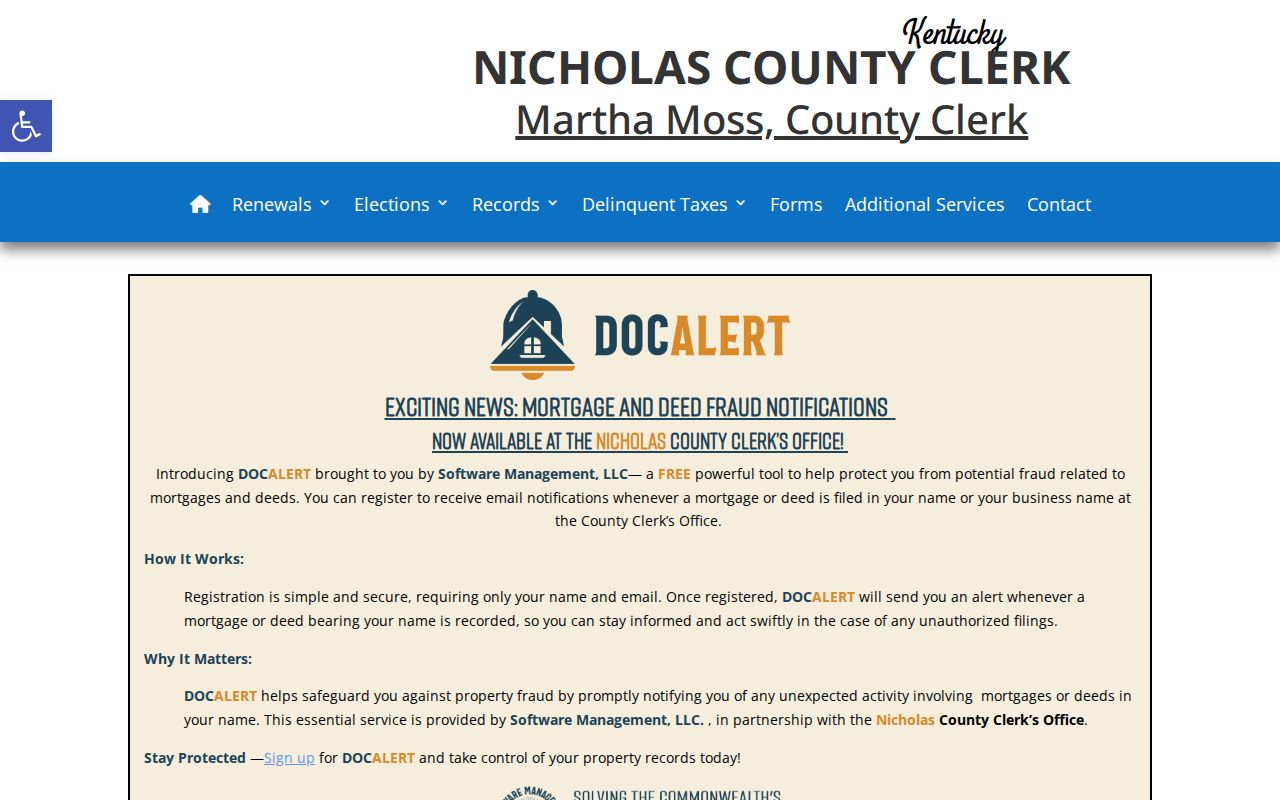
DOC ALERT for Nicholas Deeds
The Clerk promotes eCCLIX DOC ALERT for deed and mortgage filings. Registration needs a matching personal or business name and an email address. An alert flags unfamiliar recordings fast. It blocks nothing. Nor does it decide whether fraud occurred.
Review the actual image, or request it from the Clerk. Compare signatures, parties, description, and prior reference. Contact the office at 859-289-3730 about an unfamiliar filing. Seek title or legal advice about its effect.
Name Variants in Nicholas Deed Records
Nicholas County deed indexes copy names as presented for recording. One person can appear many ways. Search the surname first. Then narrow by first name or initial. Try spouse names, former names, and both sides of the index. A trust may sit under its title, its trustee, or both. Estates are just as loose. The decedent, heirs, executor, administrator, or devisees vary. Each can carry the same land under different labels.
Entities need their exact legal style. Try common abbreviations too. The Kentucky Secretary of State's business search confirms entity spelling and filing documents. A registered agent is not necessarily the person who owns or controls the real estate interest. Match the entity to the parcel through the deed description and the prior reference.
Life estates deserve extra care. The occupant and the tax-roll owner may differ. The life tenant and the remainderman may also be different people. Read the full granting and reservation clauses. For same-name parties, compare spouses, mailing addresses, legal descriptions, book-page references, and the linked parcel.
Nicholas Deed Chain Workbench
A written chain table keeps every link in view. Give each transfer its own row. Track the search year, the grantor or grantee side, the indexed name, and every variant tested. Add the instrument type, execution and recording dates, book and page, instrument number, and consideration if shown. The row should also hold the legal description, prior-recording text, plat reference, map ID, image or microfilm roll, and the next backward target.
Never collapse the two dates. A deed can be signed long before it reaches the Nicholas County Clerk, and the recording date controls its place in the public index. Label each source by type. Was it the original image, an official index, a tax assessment, a court file, a newspaper notice, or historical context? That label matters most when accounts differ.
The county's formation year is one example. The county website says 1799, while KDLA's formation chart places Nicholas as the forty-second county, formed in 1800 from Bourbon and Mason. Preserve both source-specific statements. For land-record work, apply the KDLA framework, then test earlier Bourbon, Mason, or Kentucky Land Office material where the tract's date and place require it.
Carlisle Mercury Deed Leads
The Nicholas County Public Library says it holds every Carlisle Mercury issue. The newspaper began in 1867. Its microfilm reader serves a genealogy collection. That collection also includes maps, government documents, city directories, and family files. Research requests can name a person, family, date, and place. Mailed material is available by arrangement.
Legal notices yield the richest leads. Search for master commissioner, sheriff, partition, quiet title, delinquent tax, executor, and administrator notices. Look also for affidavit of descent, plat, vacate, road, and easement notices. Record the issue date and page. A notice can reveal a prior owner, an address, a sale date, a map ID, or a deed reference. It does not replace the final deed.
One source deserves care. A Kentucky Historical Society finding aid lists a Carlisle Mercury microfilm entry. It covers only 1882 through 1886. That entry is a partial run. Use the library for breadth. Use the finding aid only for the years it actually names.
Request a Nicholas County Deed
Gather the basics first. Note the parties, instrument type, recording date, and book-page or instrument reference. Try the eCCLIX image. If it is not there, inspect the Clerk's paper or microfilm holdings in person, call the office, or submit a focused written request. The recording fee schedule concerns filing costs. It is not a universal copy price.
KRS 61.872 and the Clerk's open-records policy offer another route for records not exposed online; state whether a plain or certified copy is needed and ask the office to quote the current charge. Old books need the KDLA roll identifier. That identifier lets staff distinguish an index gap from an image gap.
Recorded, not guaranteed. Nicholas County deed records show filed instruments. They do not resolve every unrecorded interest, boundary claim, or defect, and they are not a title opinion.
Deed records support lawful land research, purchase diligence, family estate work, and house history. Never use them to stalk, harass, or harm anyone.